The part of your driveway that belongs to the road
From your property line to the pavement, the driveway is in someone else's right-of-way — the city's, the county's or SCDOT's — and each one has a spec, a permit and an inspection. We know which from the address.
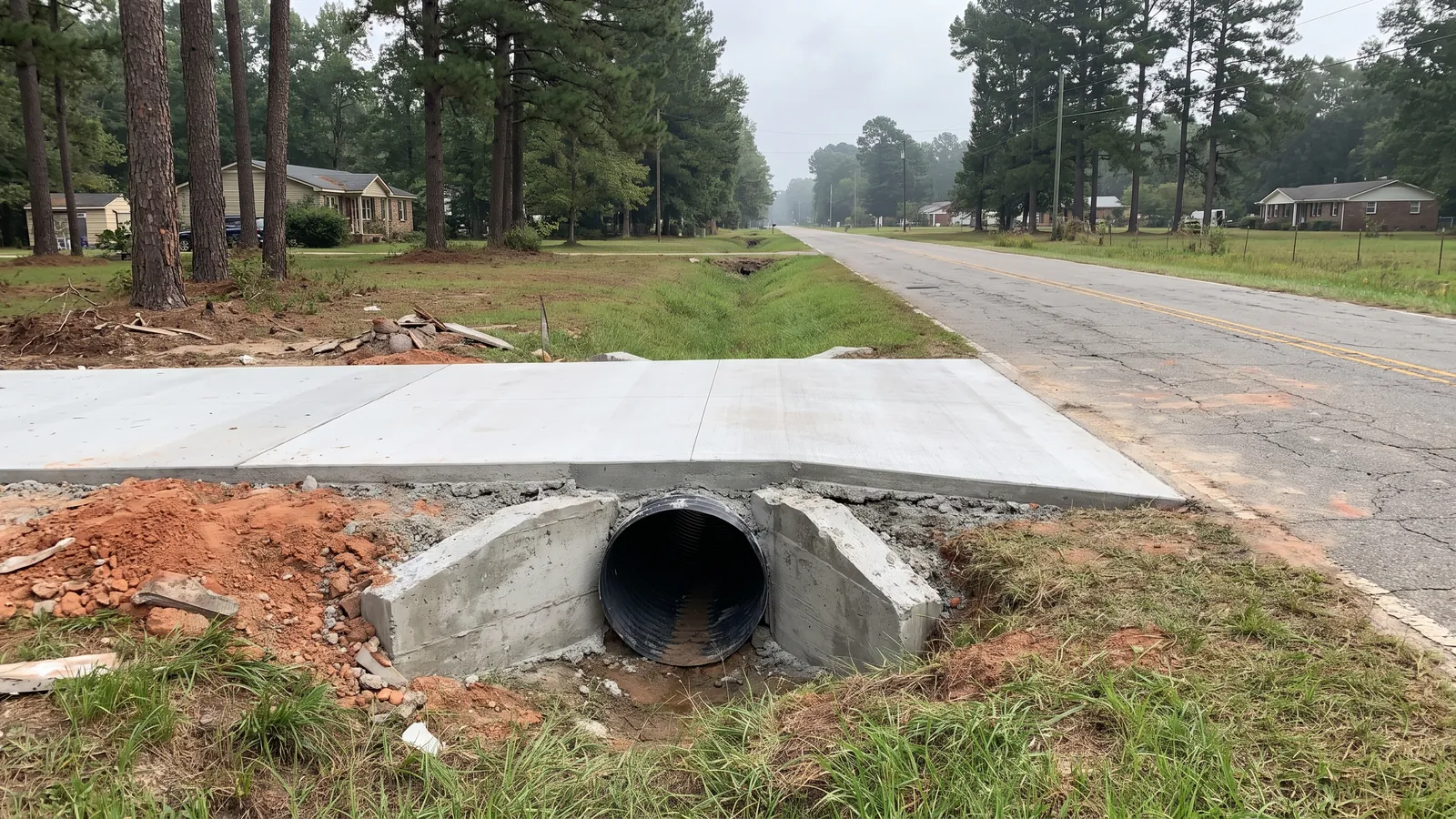
Every driveway on the Grand Strand crosses a strip of land the homeowner doesn't own: the right-of-way between the property line and the edge of the pavement, usually with a roadside ditch or swale running through it on county roads and a curb and sidewalk inside the city. Whoever owns the road regulates what's built there. In the City of Myrtle Beach it's Construction Services (843-918-1111): the apron is six inches of 3,000-psi concrete with fiber mesh — no steel or welded wire — with five-foot return radii, no more than twenty feet wide at the property line, no part within five feet of a side line or twenty feet of a corner, an expansion joint at the property line, a form inspection before the pour and a final after, and the tie-in to the street can't change how stormwater flows. In unincorporated Horry County it's County Engineering (843-915-5160), which issues a free encroachment permit with 72 hours' notice before work, good for six months: the driveway is four inches minimum for residential, expansion joints go twelve inches either side of the pipe, and the work carries a one-year warranty to the county. On a state road — US 17 and the Bypass, US 501, SC 544, SC 31, SC 22, SC 9, SC 90, US 701 — it's an SCDOT encroachment permit, also free. North Myrtle Beach, Conway and Surfside Beach each have their own form.
On county roads the apron is also a drainage structure. The roadside ditch carries stormwater from every lot on the street, and a driveway crossing has to carry it through on a pipe — bedded, sized for the ditch, with poured concrete end sections so the ends don't wash out — without raising the water in the ditch upstream, which the county's stormwater ordinance says no property owner may do to another's detriment. Undersized pipes, pipes set too shallow and pipes crushed by delivery trucks are why half the county aprons we replace are replaced. We size the pipe to the ditch, bed it, pour mitered end sections, and set the apron at the grade the county wants.
What's included
The right permit for the road
City of Myrtle Beach apron permit, Horry County or SCDOT encroachment permit, NMB, Conway or Surfside — identified from the address, filed with the drawing, inspections scheduled.
City spec aprons
6 in, 3,000 psi, fiber mesh only, 5-ft radii, ≤20 ft wide at the line, expansion joint at the line, form inspection before the pour.
County aprons and pipes
4 in minimum, expansion joints 12 in either side of the pipe, pipe sized and bedded for the ditch, poured end sections, 72-hour notice, 1-year warranty.
Drainage preserved
Ditch and swale flow carried through, never raised upstream; the tie-in doesn't change street drainage.
SC 811 first
Three working days' notice before we open the right-of-way; water, sewer, gas, cable and fiber all run there.
Sidewalk and curb
Curb cuts and sidewalk panels replaced to the city's standard where the apron crosses them.
Apron, culvert and permit cost in Myrtle Beach and Horry County
| Job | Typical price | Notes |
|---|---|---|
| City apron, replace to 6-in spec | $1,200 – $2,800 | Permit, form and final inspections, curb cut |
| County apron, no pipe | $900 – $2,200 | 4-in minimum, encroachment permit |
| County apron with new culvert pipe | $1,800 – $4,500 | Pipe, bedding, two poured end sections |
| Replace a crushed culvert only | $1,200 – $3,000 | Pipe and end sections, apron re-poured over |
| SCDOT apron on a state route | $1,500 – $4,000 | SCDOT permit, state spec |
| Sidewalk panel replacement, per panel | $250 – $500 | City standard, with the apron job |
These are 2026 Grand Strand ranges so you can budget. Your written price is itemized — removal, base, thickness, reinforcement, finish, joints, the permit and its inspections — and good for 30 days.
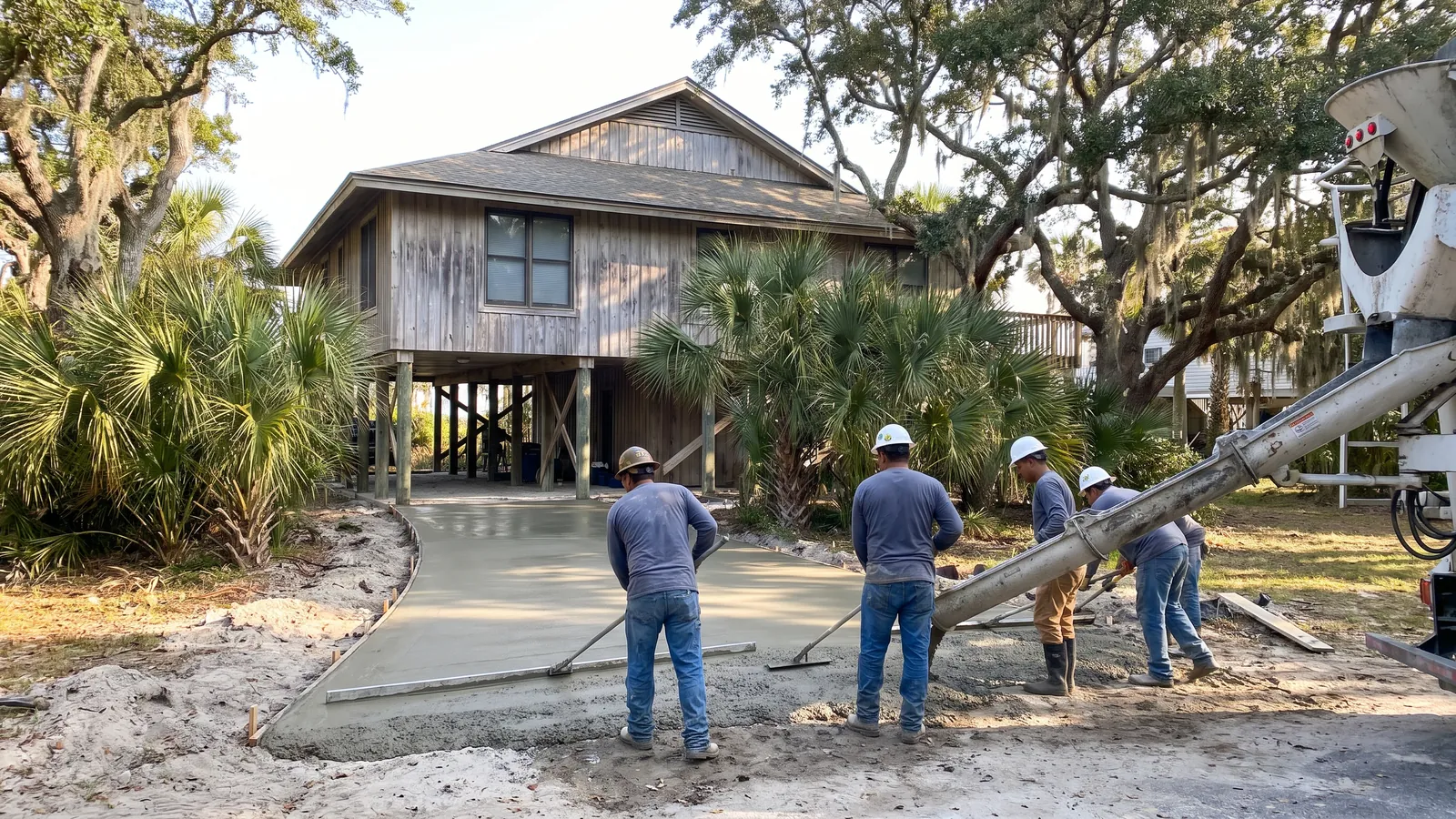
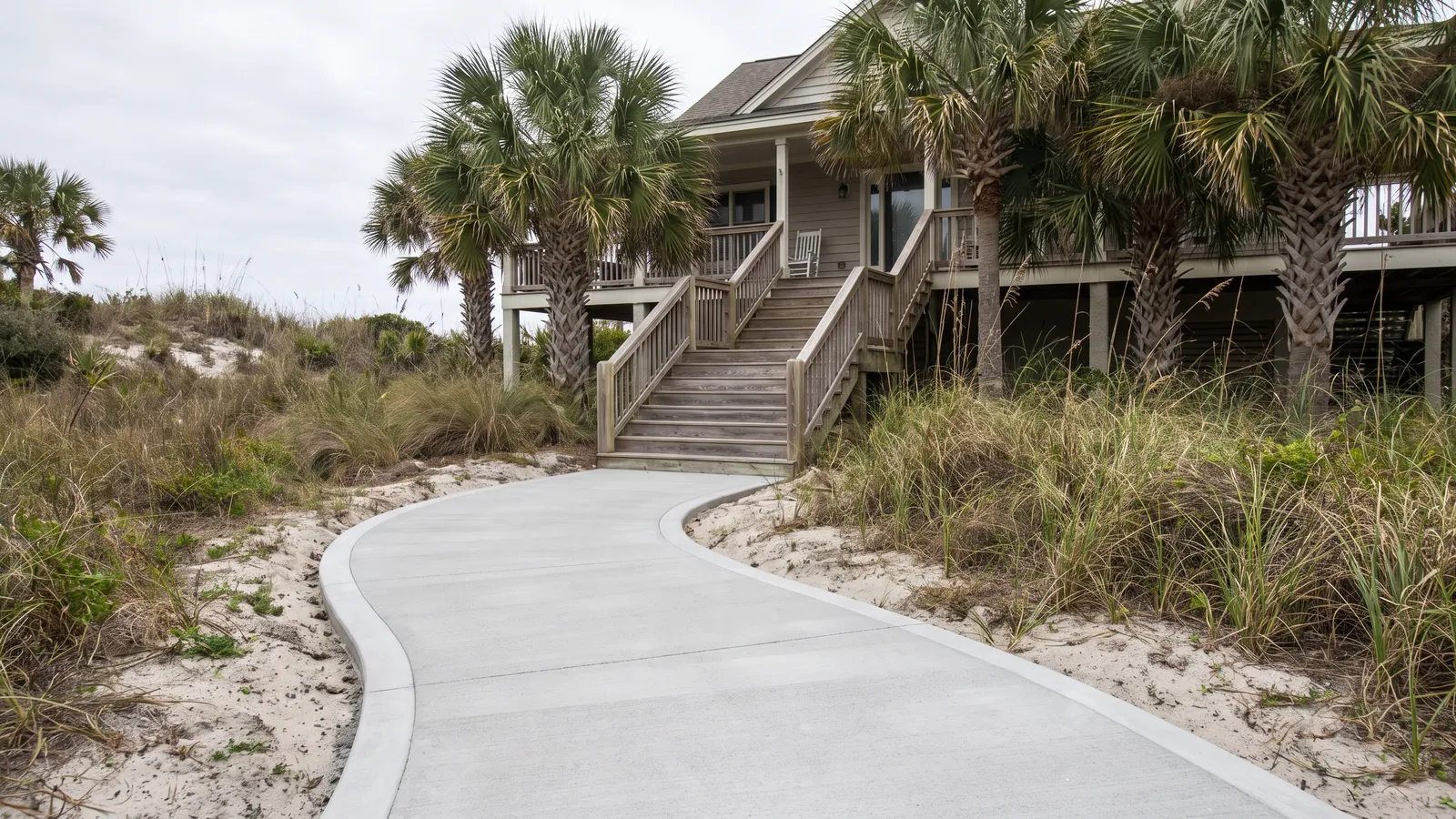
Recent work
Questions we get about aprons, culverts and encroachment permits
Who do I call to find out whose road I'm on?
Us — we check the parcel and the road ownership before we quote. The quick tells: a curb and sidewalk usually means a city street; a roadside ditch means county or state; the numbered highways are SCDOT.
Is the encroachment permit really free?
Horry County's and SCDOT's are. The City of Myrtle Beach charges for its apron permit and inspections, and we put the fee on the estimate as its own line.
How big a pipe does my driveway need?
The county doesn't publish a single minimum — it depends on the ditch. We size it to the ditch's depth and flow so the water upstream doesn't rise, and we confirm with County Engineering on the permit, because an undersized pipe is a code violation and a flooded neighbor.
The old apron is cracked and sunk. Lift or replace?
If it's dropped an inch or two and the concrete is sound, foam lifting restores the grade for a few hundred dollars. If it's cracked through, below the city's six-inch spec, or the pipe under it has failed, it gets replaced. Inside the city, any replacement has to meet the current spec.
How long does the permit take?
The county encroachment permit is typically days; the city's apron permit about a week with the inspection scheduled around the pour; SCDOT a week or two. We build it into the schedule and don't order the truck until it's in hand.