Concrete that holds up on sand, salt air and a high water table — poured by people who know whose road it's on.
Driveways and aprons with the right permit for the road, patios and pool decks, stamped concrete, golf cart pads and paths, shed and generator pads, foundations, repair, leveling and removal across the Grand Strand — compacted base, reinforcement that doesn't rust, and an itemized written price before the truck is ordered.
Insured crews · City of Myrtle Beach, Horry County and SCDOT permits handled · SC 811 before every dig · Free estimates
Twelve kinds of concrete for a beach town built on sand
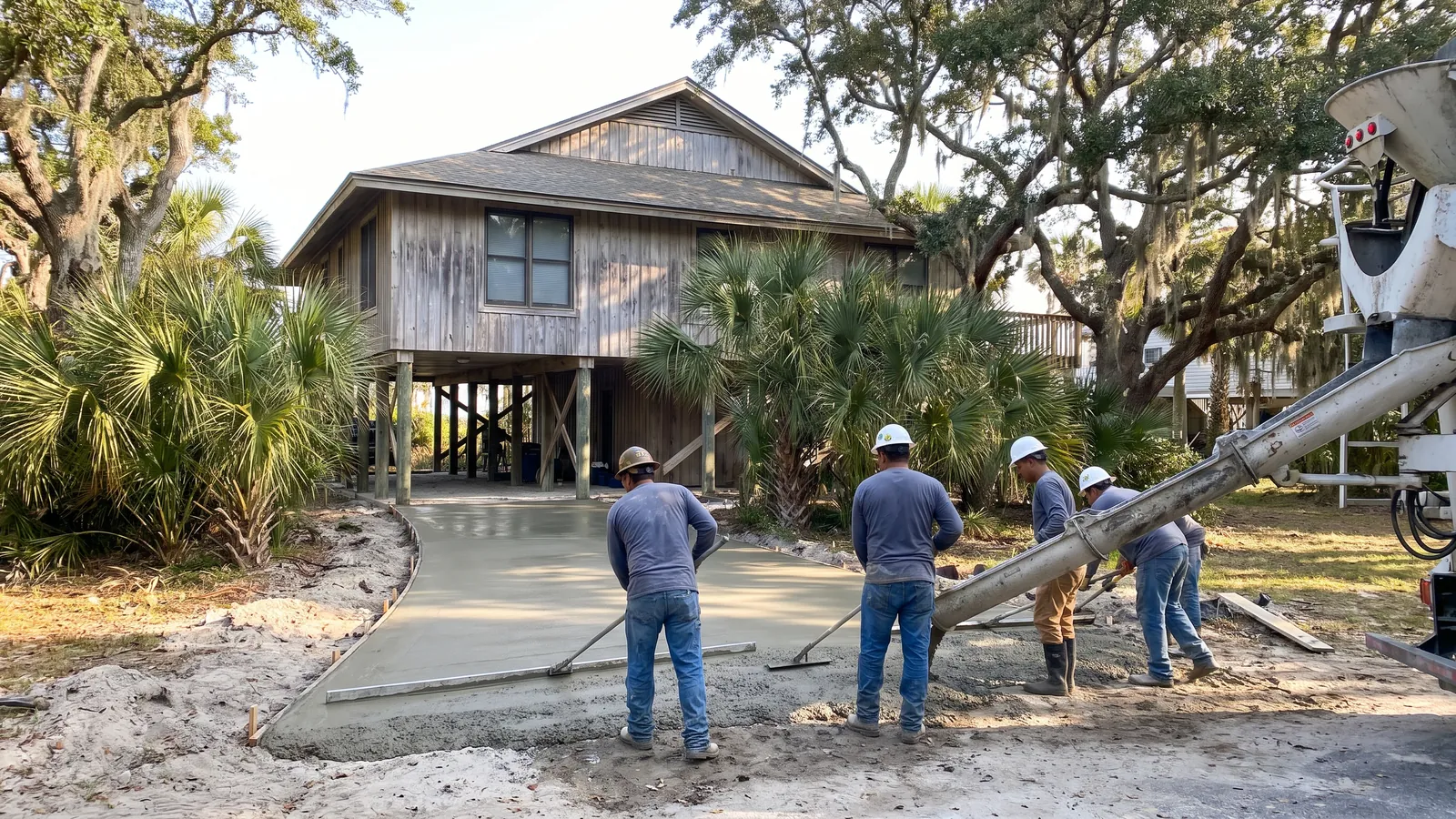
Concrete driveways
New, replaced or widened, with the apron permitted to the road owner's spec and a base compacted for sand.
Driveways →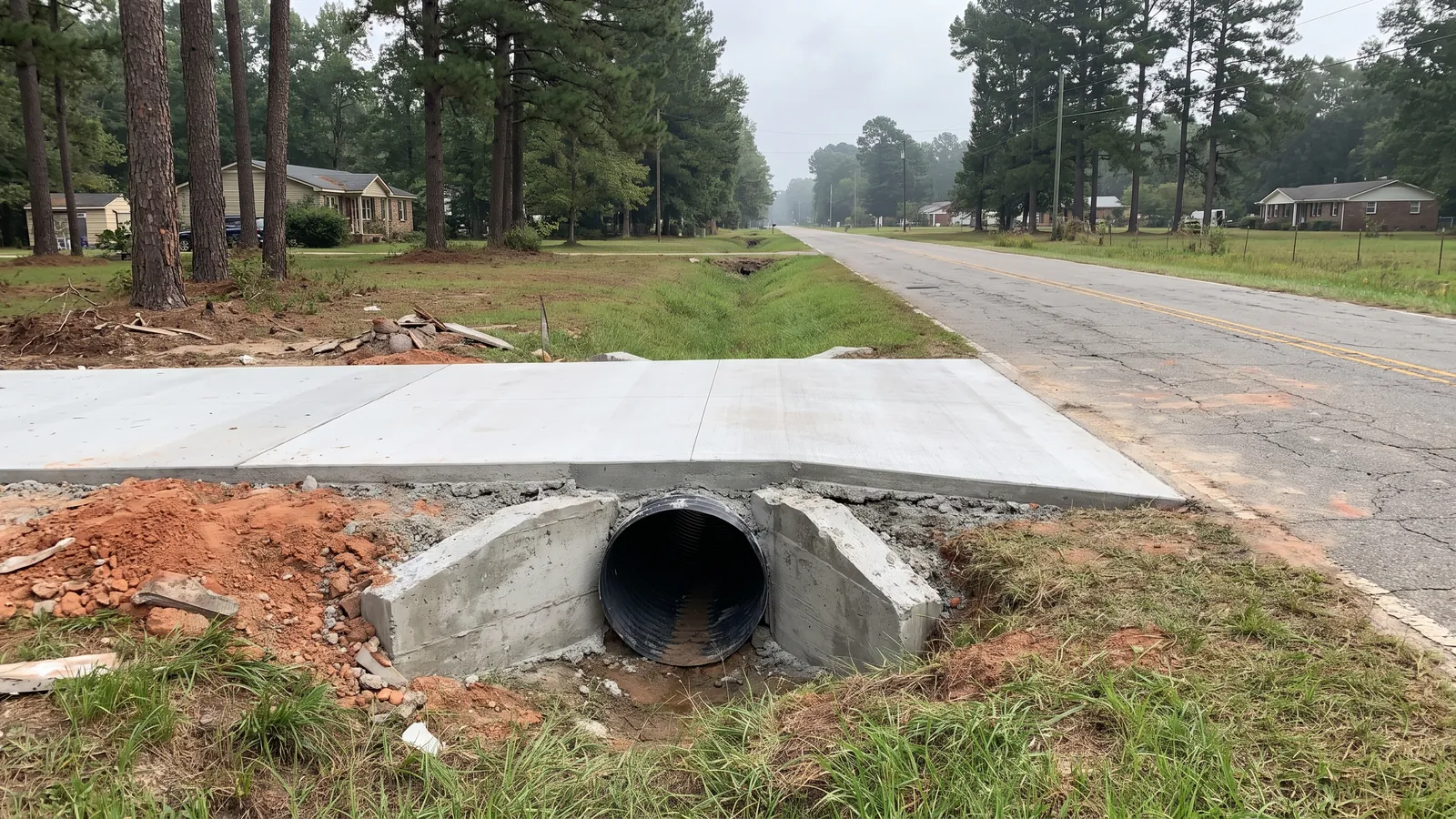
Aprons, culverts & encroachment permits
The part of the driveway in the right-of-way: county, SCDOT or city permit, pipe in the ditch, poured end sections.
Aprons & permits →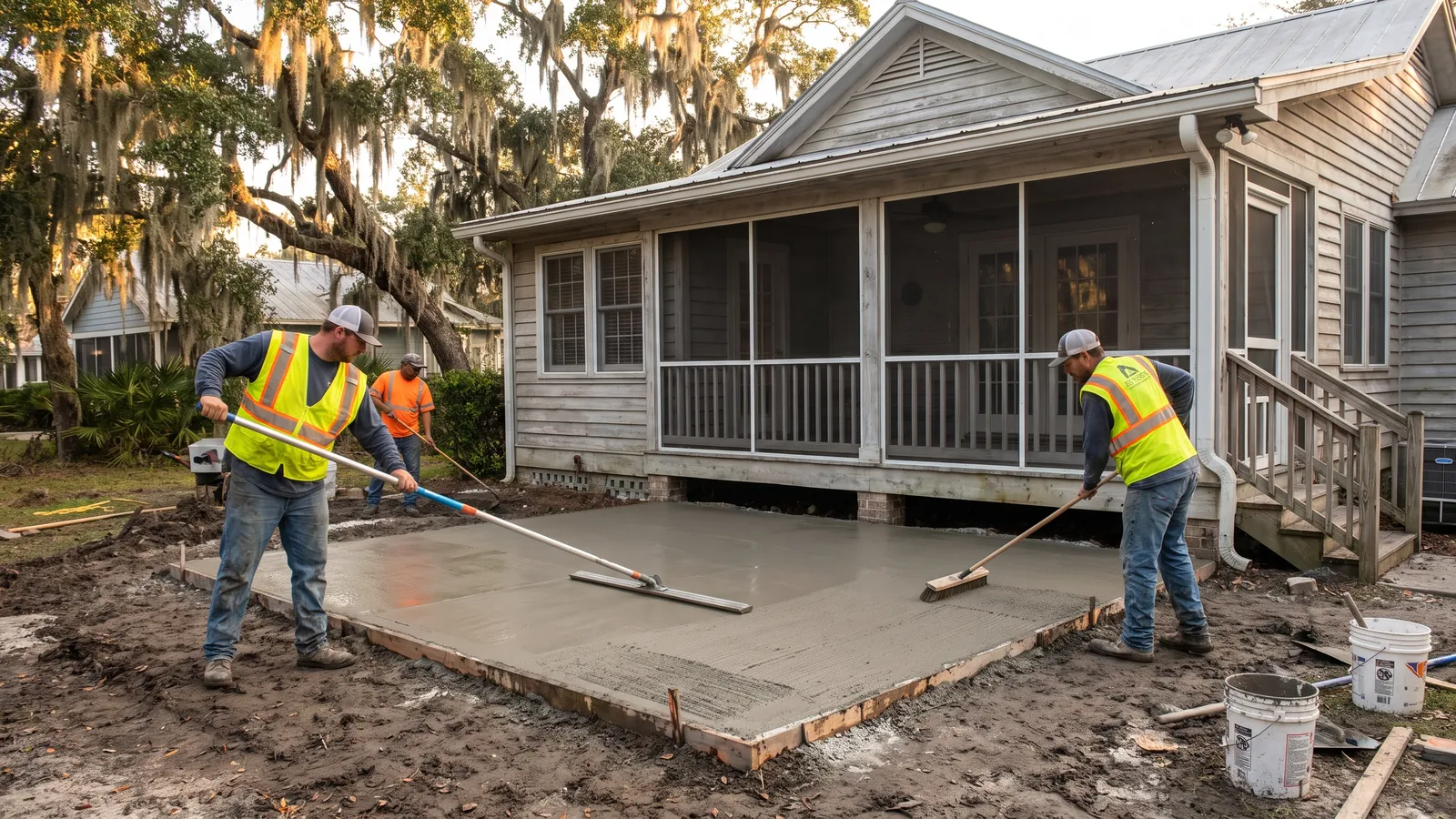
Patios & outdoor living
Broom, smooth-border or stamped, sized for the grill and the table, drained away from the house.
Patios →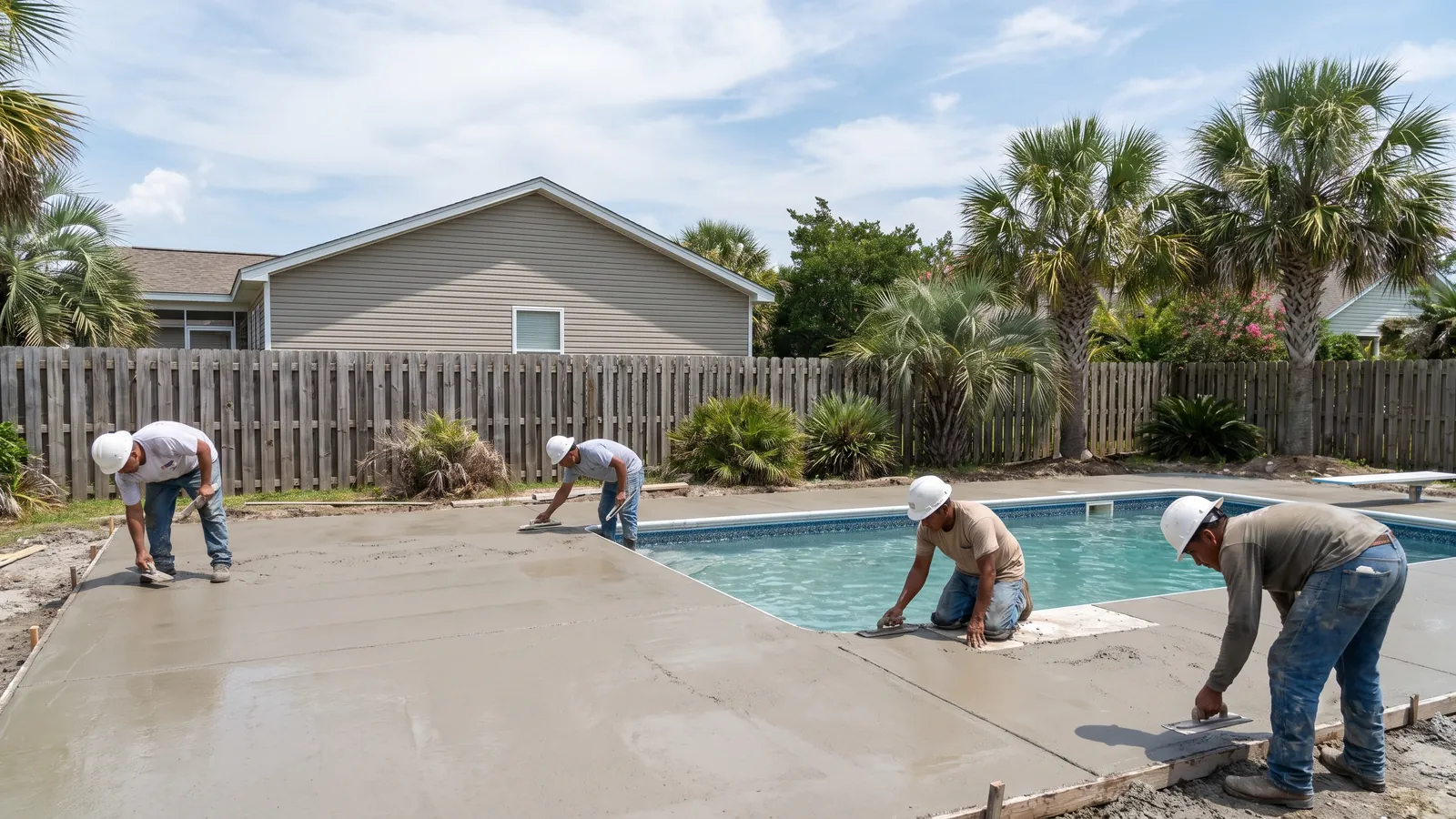
Pool decks
New decks around in-ground pools with cool, non-slip finishes and salt-tolerant reinforcement.
Pool decks →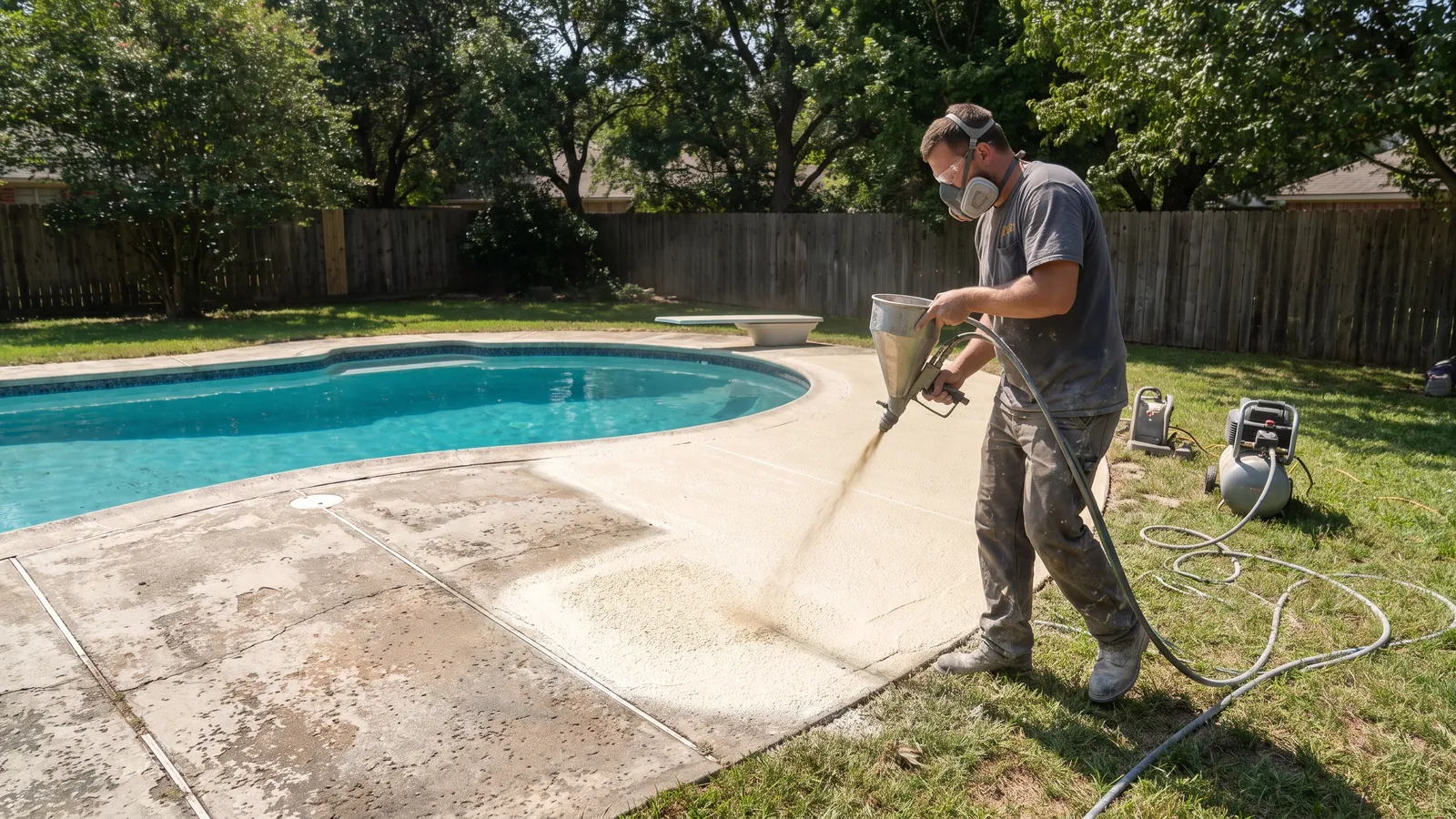
Pool deck resurfacing
Textured acrylic overlays and cool-deck systems over a sound older deck — a new surface for a third of the cost.
Resurfacing →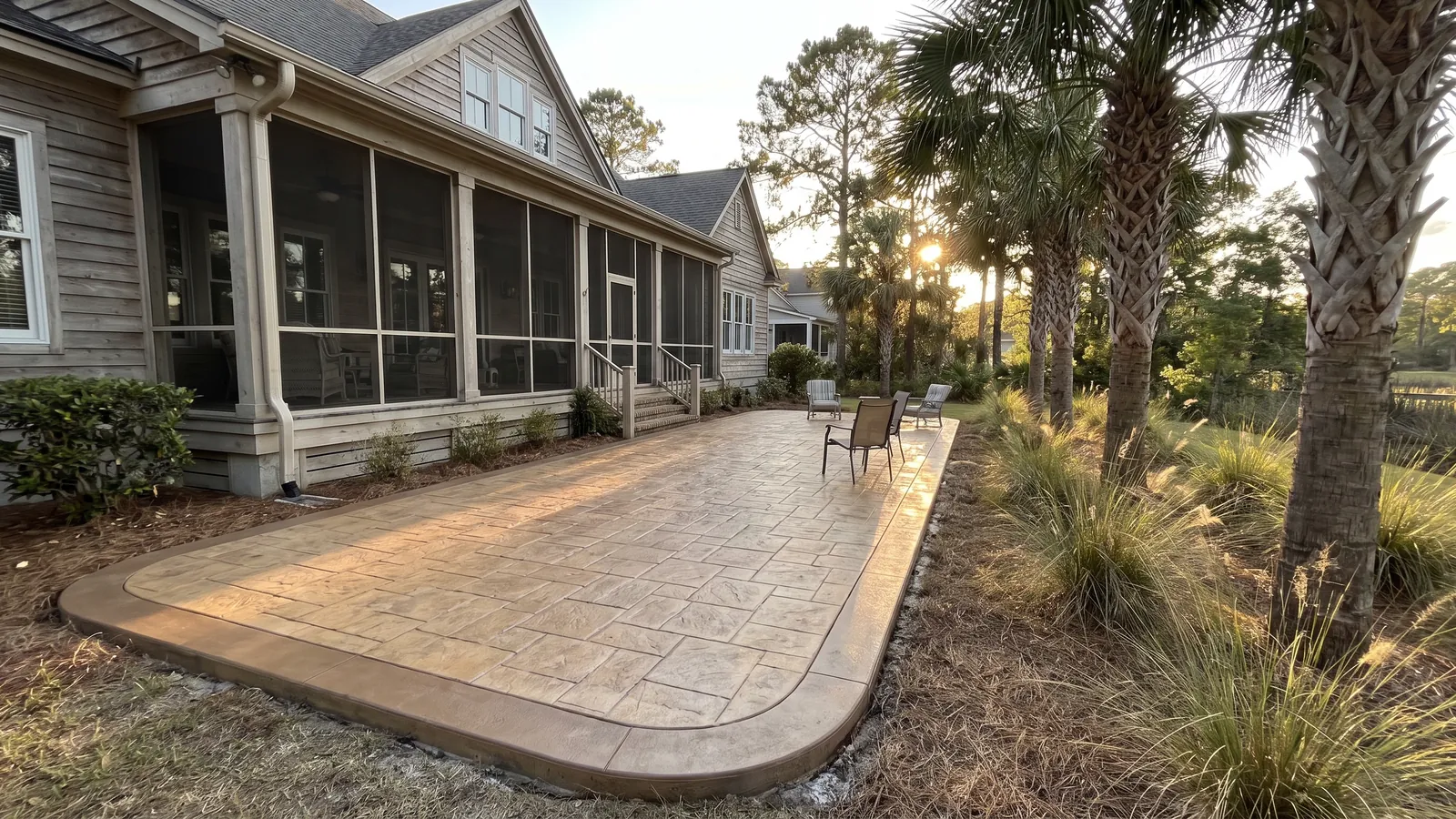
Stamped & decorative
Ashlar slate, flagstone, wood plank and exposed aggregate with integral color that doesn't fade in beach sun.
Stamped →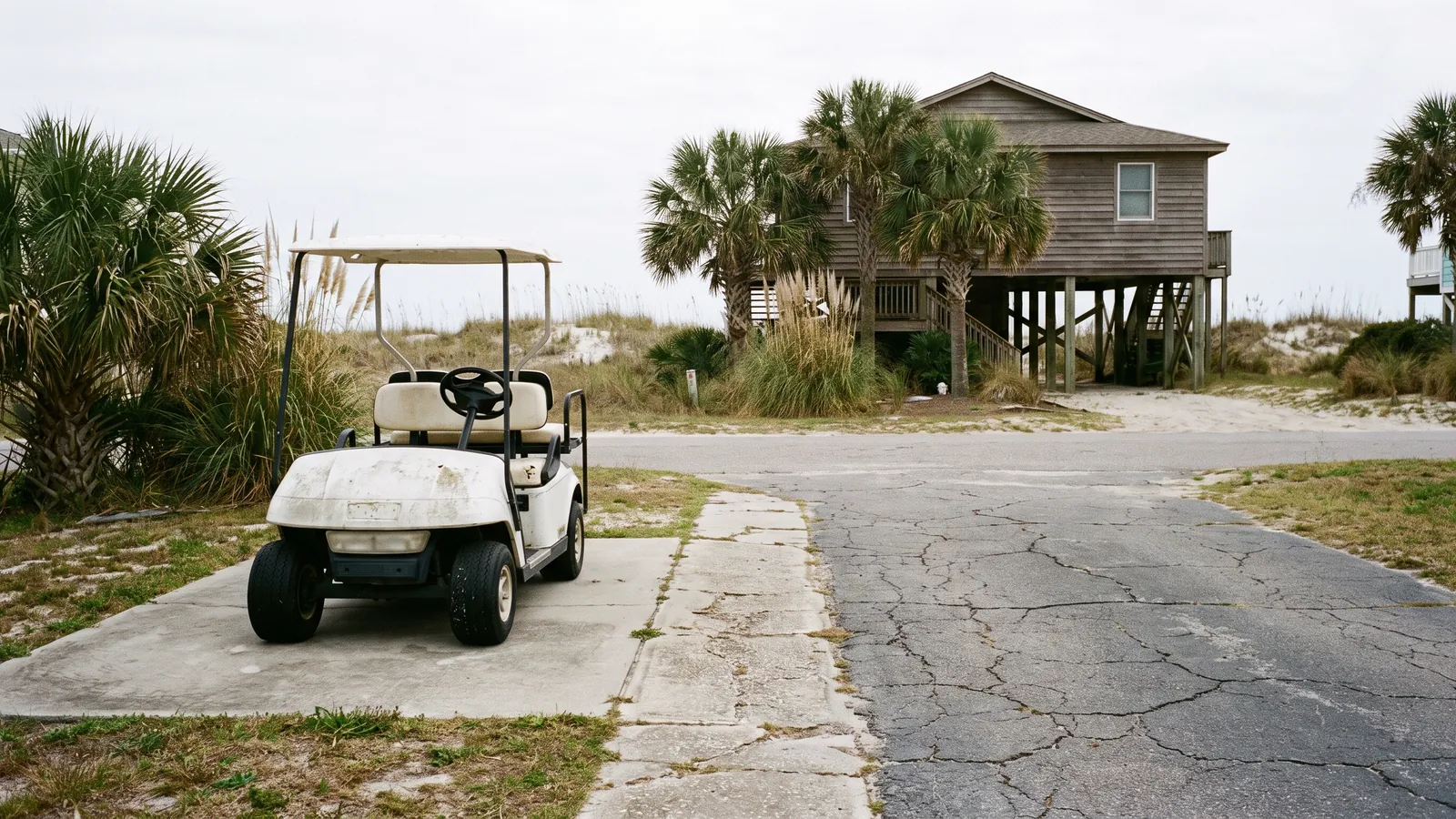
Golf cart pads & paths
The Grand Strand's own service: a pad by the drive and a path to the road, sized for the cart and the HOA.
Cart pads →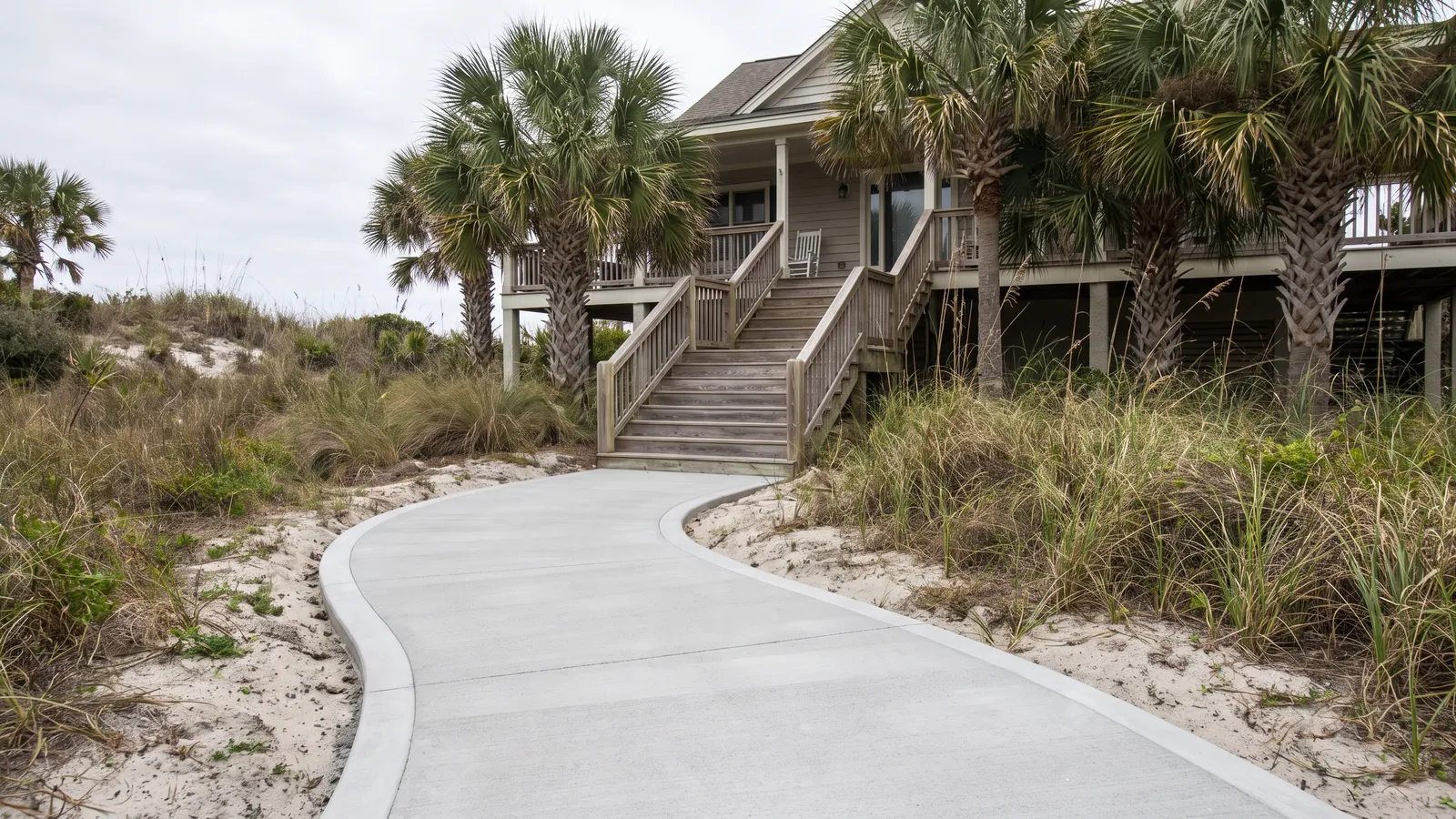
Walkways & sidewalks
Front walks to the stairs of a raised house, side paths, and city-spec public sidewalk replacement.
Walkways →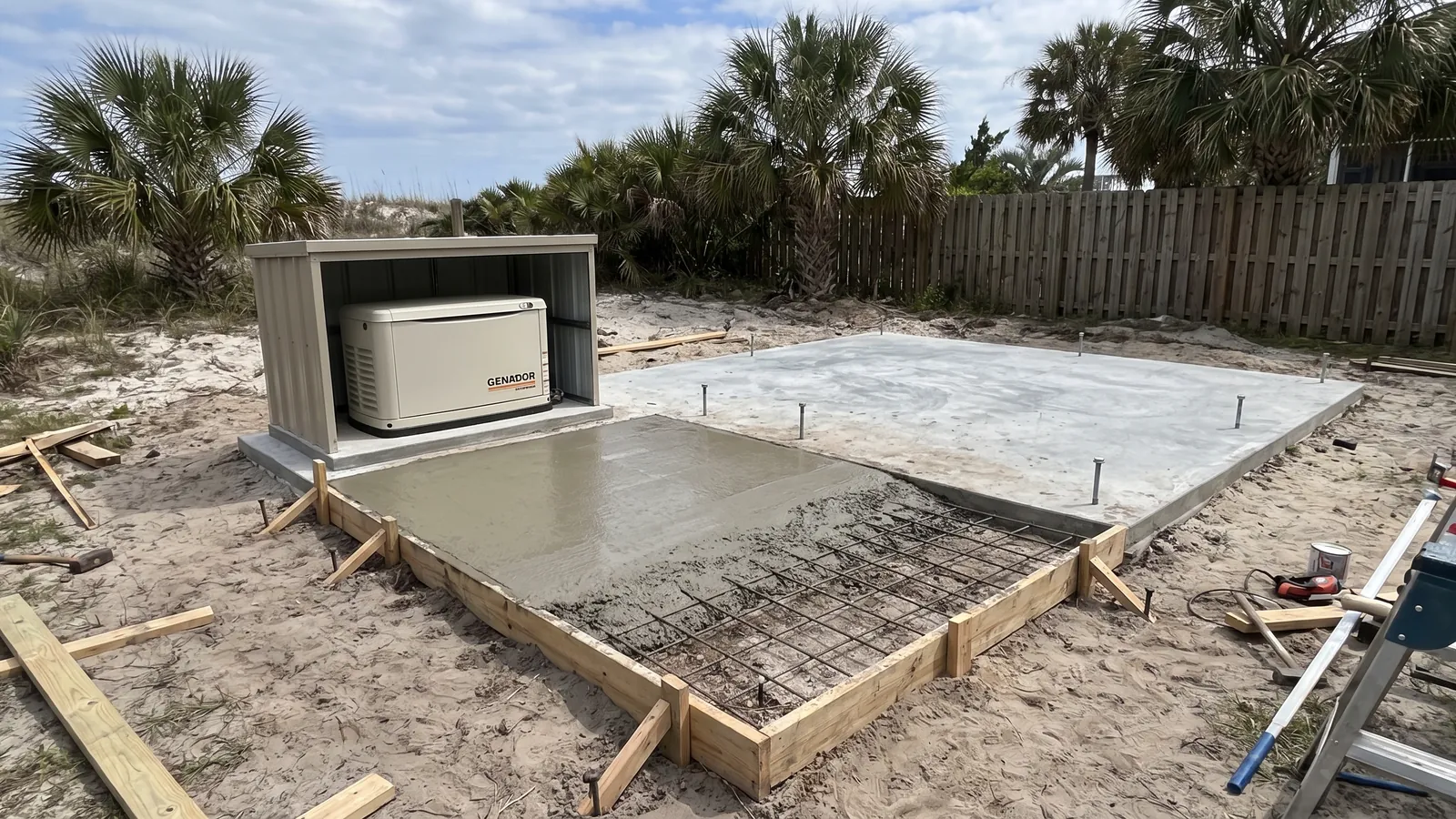
Shed, boat, RV & generator pads
Thick, reinforced, anchored where the code wants it — including the generator pad every hurricane season sells.
Pads →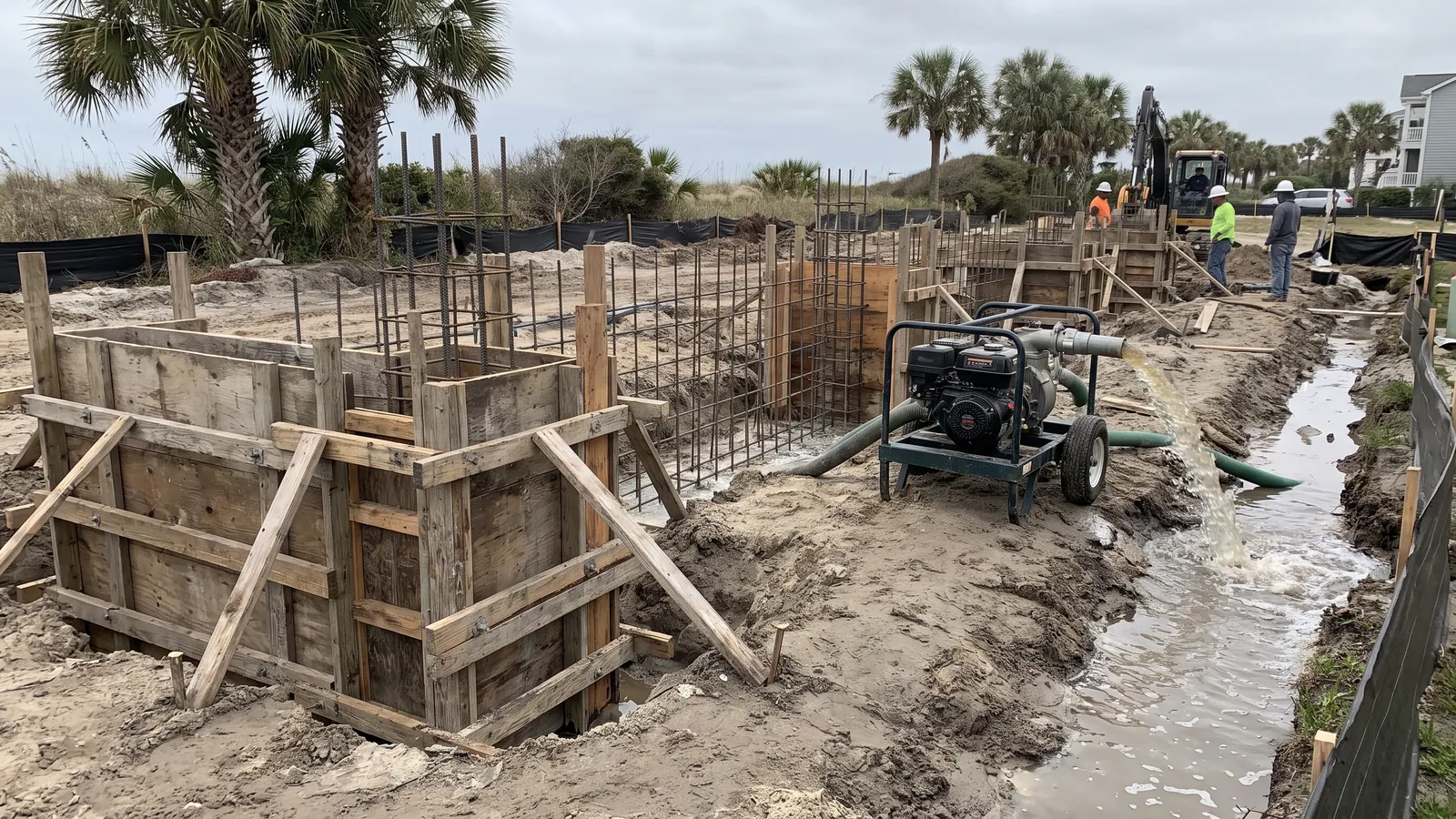
Foundations, footings & additions
Footings below undisturbed grade, stem walls above base flood, slabs that match the house in the right zone.
Foundations →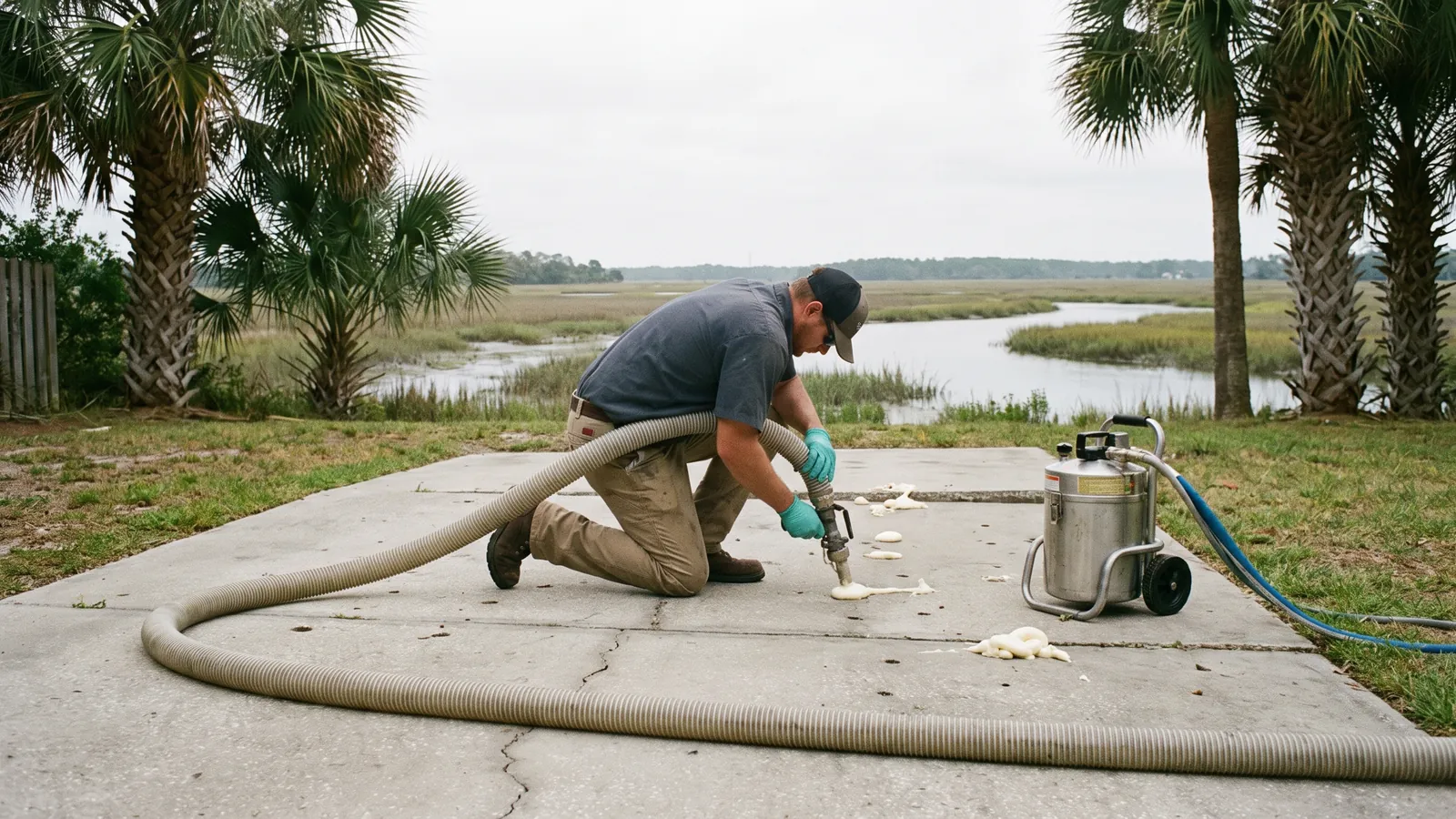
Repair & leveling
Foam lifting for sunken slabs on the sand, crack repair, spalled steps, and the honest call on replace-versus-fix.
Repair →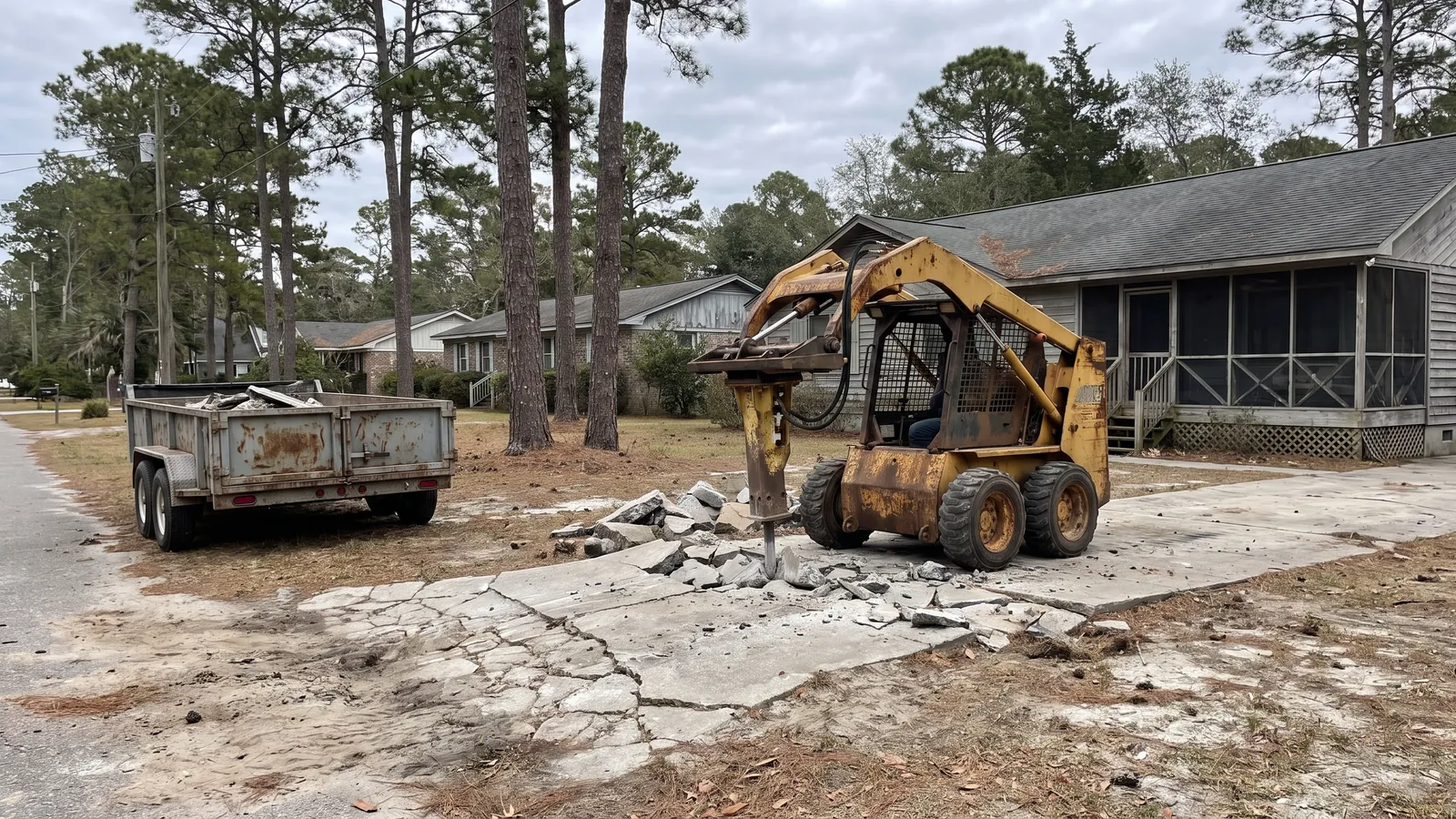
Removal & demolition
Old driveways, patios and pads broken out and hauled to the county landfill at $15 a ton.
Removal →What's between your driveway and the water table
A concrete slab on the Grand Strand is only as good as the four inches of sand under it and the rules about where the water goes. Here's the cross-section we build to, top to bottom, and why each layer is there.
| Layer | What we use | Why, on the Grand Strand |
|---|---|---|
| Surface | Broom finish, smooth border, or stamped with integral color and a UV-stable sealer | Broom for grip when it's wet; sealer because beach sun and salt bleach cheap color in two summers |
| Slab | 4 in residential (6 in at the city apron, boat and RV pads), 3,000–4,000 psi, air-entrained | The city's apron spec is 6 in / 3,000 psi; 4,000 psi and a 0.40 water-cement ratio within reach of salt spray |
| Reinforcement | Fiber mesh, or epoxy-coated rebar on chairs for structural work; never bare mesh lying on the sand | The city requires fiber only in aprons; bare steel near the ocean rusts and spalls the slab from inside |
| Joints | Control joints at 8–10 ft, expansion joint at the property line and against the house and the garage | Sand lets slabs move a little; joints decide where the crack goes |
| Base | 4 in of compacted crusher run or clean sand, plate-compacted in lifts, on undisturbed or compacted subgrade | Uncompacted beach sand is why driveways here sink at the apron and crack at the garage |
| Drainage | Grade away from the house, swale and ditch flow preserved, pipe in the ditch where the county says so | Horry County's stormwater ordinance forbids blocking a swale to a neighbor's detriment; NMB wants approval for more than 8 in of fill |
Three numbers that decide most Grand Strand concrete jobs
Horry County's growth since 2020
From 351,000 people to 427,551 in five years, the fastest-growing part of the Carolinas — 6,511 building permits in 2025, Carolina Forest grown from 3,400 people to 23,000 since 2000, and a third of the county past 65. New homes need first driveways; the 1970s–90s stock that makes up 42 percent of the city needs its second.
Short-term rental listings in Myrtle Beach
Every one of them needs off-street parking, and North Myrtle Beach's 2021 rules say it has to be fully on private property, not on the sidewalk or in the landscape bed. Parking pads, widened drives and cart pads for rental houses are a steady part of our week.
The Waccamaw's record crest at Conway, 2018
Florence dropped 23.63 inches on Loris and put the river three feet over Matthew's record. A quarter of the county is in the 100-year floodplain and the 2021 FEMA maps added 10,500 parcels. Where the water goes decides how we grade, whether we can add fill, and how high a slab has to sit.
Four things that keep our phone ringing
The sunken apron
The driveway settles where it meets the street, because the original builder poured on loose sand over the trench for the utilities. It can often be foam-lifted; sometimes the apron is replaced to the city's six-inch spec.
Leveling →The crushed culvert
A driveway over a roadside ditch on a pipe that was too small or too shallow. The pipe collapses, the apron drops, and the ditch backs up into the neighbor's yard — which the county's stormwater ordinance makes your problem.
Culverts →The rusting pool deck
Bare wire mesh laid on the sand instead of chaired in the slab, and the salt air found it. Rust expands, the surface spalls in sheets, and the deck has to be resurfaced or replaced.
Resurfacing →The heaved slab
West of the Waterway the soils turn to clay — Bladen, Meggett, Yauhannah — that swells wet and shrinks dry. A shed slab or an addition poured without a prepared base lifts in the wet season and cracks in the dry one.
Foundations →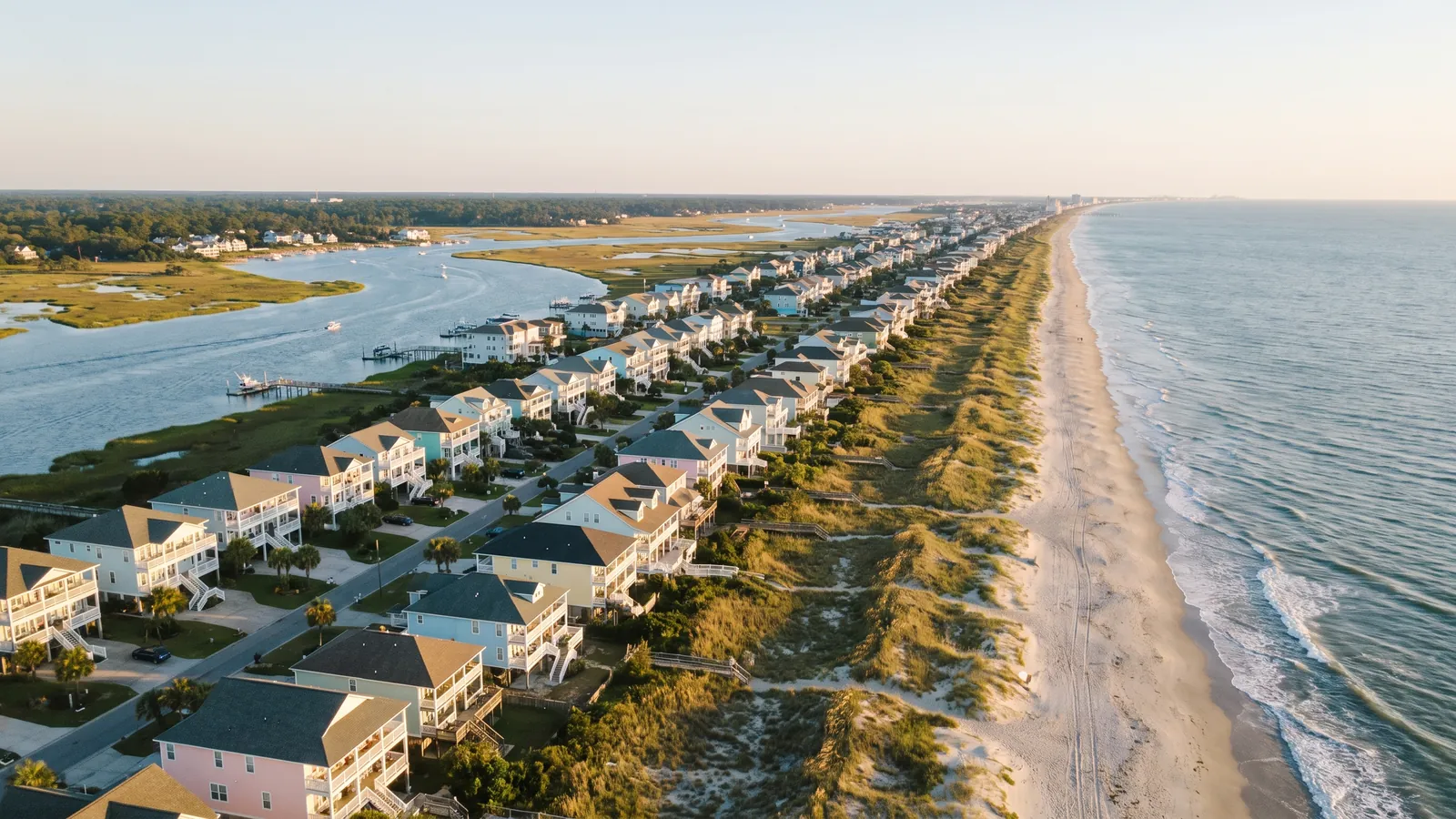
The Grand Strand is sixty miles of beach on sand, water and three different sets of rules
Myrtle Beach sits on a Pleistocene barrier complex — the sand ridges that pushed the Pee Dee, Waccamaw and Black rivers south to Winyah Bay — and everything east of the Intracoastal Waterway is built on it: excessively drained dune sand on the ridges, poorly drained Leon sand with a hardpan and a water table a foot or two down in the flats between. Cross the Waterway toward Conway and Carolina Forest and the ground changes to the clayey Bladen and Meggett soils of the river terraces, and to the four hundred Carolina bays — more than any county in the state — with their peat bottoms. The county's own planning documents say the majority of its soils are poorly drained loamy sands, that 88 percent have severe septic limits and that a quarter of the land is in the 100-year floodplain. None of that stops concrete; all of it decides how we build it.
Then there's who owns the road. Horry County maintains 1,425 miles of its own roads, SCDOT another 1,500 miles of state and US highways through the county, and the cities — Myrtle Beach, North Myrtle Beach, Conway, Surfside Beach — the streets inside their limits. A driveway apron is permitted and inspected by whichever of them owns the pavement, and the specs differ: the city wants six inches of fiber-mesh concrete at 3,000 psi with five-foot radii and a form inspection; the county wants four inches, expansion joints a foot either side of the pipe, and a one-year warranty on a free encroachment permit with 72 hours' notice; SCDOT wants its own encroachment permit. Then the HOA in Carolina Forest wants a surveyor's plat with the application, and Barefoot's review committee decides driveway widenings case by case.
And the water. Hugo's thirteen-foot surge took 43 percent of Garden City's beachfront in 1989; Floyd dropped almost fifteen inches on Myrtle Beach in 1999; Matthew and then Florence put the Waccamaw at Conway over its banks for weeks, Florence at a record 21.16 feet in 2018; Isaias came ashore just up the coast in 2020, Ian at Georgetown in 2022, and Debby put seventeen inches on Loris in 2024. We grade every slab to send water away from the house without sending it next door, we pipe the ditch where the county says so, and we don't add fill in a flood zone without the approval it needs. The boring parts are the job.
Five steps from the call to the cure
Call or send the form
A cracked driveway, a new house that needs its first apron, a cart pad for the rental — tell us what you're after. We answer around the clock.
We measure and look at the water
Usually within a day or two: square footage, the ditch or swale, the slope, where the truck can park, and whose right-of-way the apron is in.
Written, itemized price
Base, thickness, reinforcement, finish, joints, removal, the permit and its inspections — every line, good for 30 days. No deposit until you approve.
Permit, 811, forms, inspection
We pull the encroachment or apron permit, SC 811 marks the yard, forms go in, and the city or county inspects before the pour where they require it.
Pour at first light, cure a week
Pours start early to beat the heat and the afternoon storms. Walk on it the next day, park on it in seven, and we come back to cut the joints and seal if specified.
From Little River to Pawleys Island, and inland to Conway, Loris and Aynor
We're across Myrtle Beach every week — the Grande Dunes and Arcadian Shores end, the oceanfront and Pine Lakes, Market Common and the south end, Forestbrook and the 501 corridor — and across the Waterway in Carolina Forest, where the new neighborhoods are and the HOAs want a plat with every application.
Up the Strand we cover North Myrtle Beach, Little River and Longs; inland Conway, Red Hill, Socastee and Burgess, Loris and Aynor; and down the coast Surfside Beach and Garden City, Murrells Inlet, and Pawleys Island and Litchfield in Georgetown County.
See the full service area →
Questions Grand Strand homeowners ask us
How much does a concrete driveway cost in Myrtle Beach?
In 2026 a plain broom-finish driveway on the Grand Strand runs about $6 to $10 per square foot installed, reinforced — so a typical two-car driveway of 500 to 650 square feet lands between $3,500 and $6,500, and a long drive to a raised beach house with an apron and a culvert can reach $10,000 to $15,000. Stamped or colored work is $12 to $20 per square foot. Tearing out an old driveway adds $1.10 to $1.80 per square foot plus the landfill's $15-a-ton concrete fee. Every price we give is in writing after we've measured the site and checked where the water goes.
Do I need a permit for a driveway in Myrtle Beach?
It depends on whose road you're on. Inside the City of Myrtle Beach, anything in the street right-of-way — the apron — needs a permit from Construction Services, and the city's spec is strict: six inches thick, 3,000 psi, fiber mesh, five-foot return radii, no wider than twenty feet at the property line, a form inspection before the pour and a final after. In unincorporated Horry County the driveway itself is exempt from a building permit, but the apron, pipe or culvert in a county right-of-way needs a free encroachment permit from County Engineering with 72 hours' notice. On a state road — US 17, the Bypass, 501, SC 544, 31, 22, 9, 90, 701 — it's an SCDOT encroachment permit. North Myrtle Beach, Conway and Surfside have their own. We pull the right one before the truck is ordered.
Why do slabs sink and crack so much around here?
Sand, water and salt. Most of the Grand Strand sits on marine-terrace sands with a water table one to three feet down — the Leon soils under half the beach have a hardpan within thirty inches that holds water above it — and inland toward Conway the soils turn to clay that swells and shrinks. A slab poured on unprepared sand settles when the water moves the fines out from under it; a slab poured on wet clay heaves. Salt air finishes the job on anything with unprotected steel in it. The fix is boring: compacted base, fiber or coated reinforcement, a proper thickness, control joints, and drainage that moves water away from the slab instead of under it.
Can you pour a golf cart pad or path?
Yes, and it's one of the most common jobs we do. South Carolina lets a permitted golf cart run on roads posted 35 mph or less within four miles of the registered address in daylight, so most Grand Strand homes want a cart pad beside the driveway or a path to the street. A four-inch reinforced pad, usually six by twelve feet, runs $700 to $1,500; a path to the road is priced by the foot. HOAs in the golf communities usually need to approve it, and we handle the drawing.
Do you work in flood zones?
All the time — about a quarter of Horry County is in the 100-year floodplain and the 2021 FEMA maps moved more than ten thousand parcels into one. Flatwork like a driveway or a patio is fine in an AE zone; the rules bite on structural slabs and fill. The City of Myrtle Beach wants new living space three feet above base flood elevation, North Myrtle Beach a foot, and North Myrtle Beach also requires stormwater approval if a project moves more than eight inches of soil. We design around the zone instead of fighting it: elevated stem walls, flood vents, and no fill that sends water next door.
Do you really answer at night?
24 hours a day, every day. A person picks up, takes your details, and you hear from an estimator the next morning — usually with an on-site visit the same week.