Concrete or pavers at the beach: an honest comparison
We pour concrete, so you'd expect a sales pitch. Here's the real trade-off instead: pavers can be relaid when the sand moves and never crack; concrete is one slab that doesn't let weeds and sand in and costs less. Which wins depends on your ground and your patience.
Up-front cost
On the Grand Strand in 2026 a broom-finish concrete driveway runs $6–$10 per square foot installed and a stamped one $12–$20; a paver driveway runs $14–$25 per square foot depending on the paver, the pattern and the edge restraint, and a paver patio about the same. For a plain surface, concrete is a third to a half the price of pavers; for a decorative look, stamped concrete is roughly the cost of a basic paver and a good deal less than a premium one.
What sand does to each
Both sit on a compacted base, and both fail if the base isn't there. The difference is what happens when the sand moves anyway — a utility trench settles, a downspout washes a void, a bay edge compresses. A paver surface follows the ground: it dips, individual pavers tilt, sand and weeds move into the joints, and the dip grows. A concrete slab bridges small voids and then, when the void gets big enough, cracks or sinks as a unit. The repair is where they part ways: a settled paver area is lifted, the base re-compacted and the same pavers relaid, invisibly, for a few hundred dollars; a sunken concrete slab is foam-lifted (also a few hundred dollars, if it's sound) or replaced. Pavers never crack, because each one is small; concrete always cracks somewhere, and control joints decide where.
Weeds, sand and ants
Paver joints fill with beach sand, grow weeds and host ants, and polymeric sand has to be reapplied every few years to keep them out; edge restraints work loose and the outer rows spread. A concrete slab has no joints for any of that — a sealed, jointed slab is the lowest-maintenance surface on the Strand, which is why most pool decks here are concrete.
Heat, salt and sealing
Both get hot in August; light colors and textures stay cooler on either. Salt air doesn't bother pavers (there's no steel) and doesn't bother concrete built with fiber or coated steel; it destroys concrete with bare mesh near the surface. Stamped concrete needs resealing every two to three years to hold its color; pavers need joint sand every few years and benefit from sealing too. Call it even.
The HOA
Most Grand Strand communities accept either; a few golf communities prefer pavers at the entry or require a paver or stamped border on a plain drive; a few in the older beach towns prefer plain concrete for consistency. The committee's guidelines decide, and we've drawn both.
Twenty years on
A paver driveway that's been maintained — joints sanded, settled areas relaid — looks the same at twenty years as at one, and that maintenance has cost roughly the price of the original concrete alternative. A concrete driveway that was built on a real base, jointed, reinforced for the salt and resealed if it's stamped looks like a twenty-year-old concrete driveway: a few hairline cracks in the joints, a lifted section or two foam-lifted along the way, and a third of the money spent. A concrete driveway that was poured on loose sand with mesh on the bottom was replaced at year twelve.
Our honest recommendation
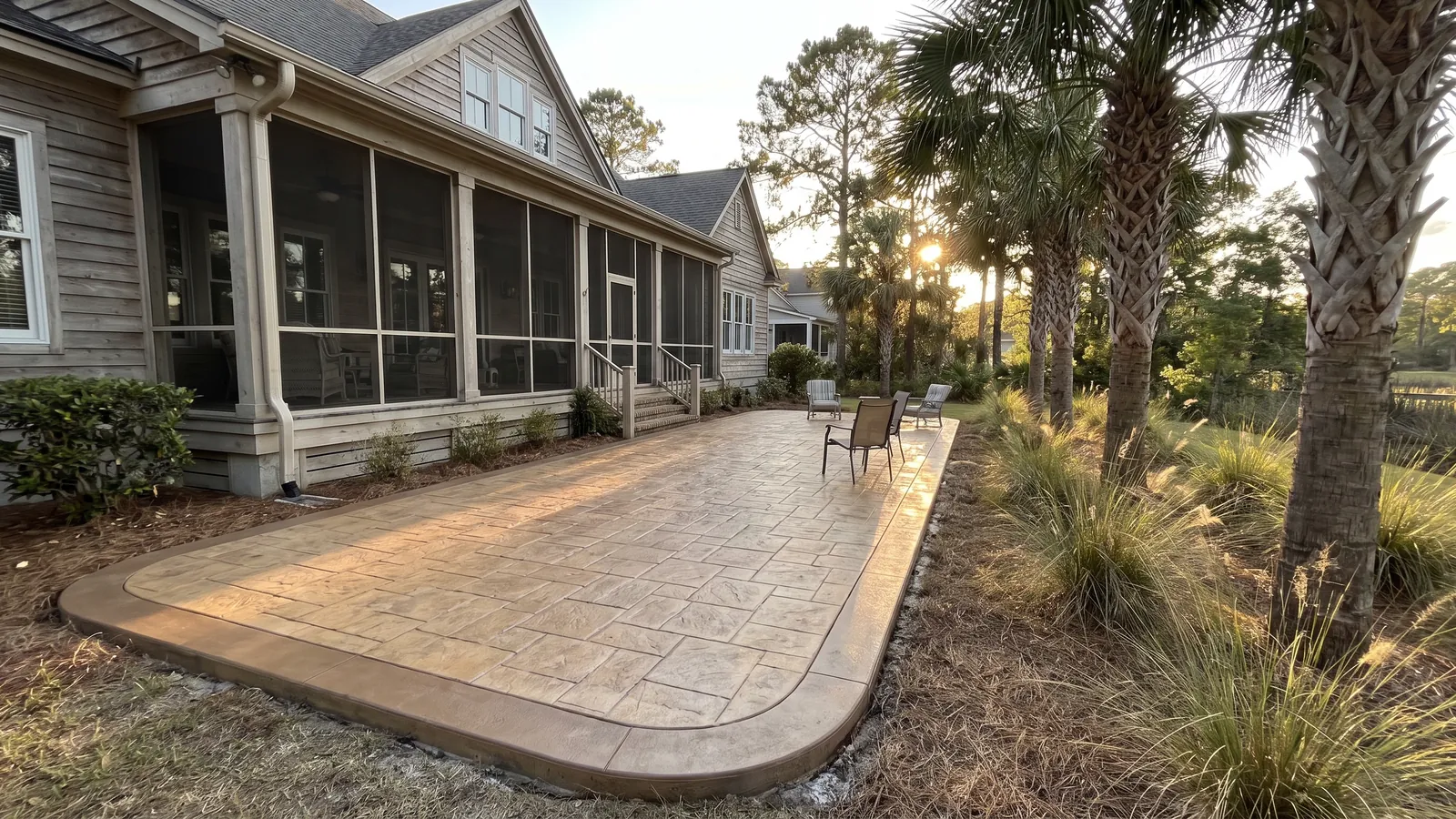
Pavers if you want a surface you can take apart and put back, you're on ground that's going to move (a bay edge, the Socastee flats), and the maintenance doesn't bother you. Concrete if you want the least maintenance, the lowest cost, a pool deck without joints, or a slab you can drive a boat trailer onto — built on a compacted base with reinforcement that can't rust. And if what you want is the look of stone at concrete's price, stamped concrete with a border is the answer most of our Grand Strand customers land on.
Common questions
Can you pour concrete over my old pavers?
No — pavers aren't a stable base. They come out, the base is re-compacted, and the slab goes on that. The pavers are often worth keeping or selling.
Which is better around a pool?
Concrete, for most people: no joints for sand and ants, a cool-deck or knockdown texture for bare feet, and a single sealed surface. Pavers around a pool trap sand and shift at the coping unless the edge restraint is perfect.
Do pavers really not crack?
Individual pavers almost never crack; the surface settles and shifts instead. Concrete cracks at the joints by design. Whether you'd rather have a tilt or a hairline is the whole question.
Is stamped concrete as good as the real stone look?
From the driveway, yes; on your knees, you can tell. A stamped slab with a smooth border and a UV-stable sealer, resealed on schedule, is the most-chosen decorative surface on the Strand because it's two-thirds of the look for half the price.
Related: Stamped concrete · Concrete driveways · Pool decks · Why concrete sinks here